HylightPDF

Digital library & secure reader

Every highlight saved.
Never lost.

Hylight is a white-label digital library and secure reader for organizations whose content is their business — built so publishing a new edition never costs a reader their work.

Structured Literacy Foundations Edition 1 p. 1

Explicit instruction

Explicit instruction never leaves the alphabetic principle to chance. Each new sound–spelling correspondence is modeled by the teacher and practiced until it becomes automatic for every learner in the room.

This planning note on scheduling, materials budgets, and room assignments will be revised by the editorial team before the next printing and should not be treated as final classroom guidance.

Explicit instruction

Explicit instruction never leaves the alphabetic principle to chance. Each new sound–spelling correspondence is modeled by the teacher and rehearsed until it becomes automatic for every learner in the room.

The planning note was removed in this edition.

Maria's annotations

Highlight On this edition

modeled by the teacher and practiced until it becomes automatic

Highlight On this edition

Decodable passages give beginning readers controlled practice.

Highlight On this edition

This planning note on scheduling, materials budgets, and room assignments

Your reader marked up Edition 1. Flip to Edition 2 — the same file you would publish next month — and watch what happens to her work.

The problem

A new edition shouldn't punish the people who read it closely.

Publishing an update should be good news. For your readers it usually isn't. Page numbers shift, a paragraph moves, one sentence gets reworded — and every highlight, note and bookmark they made is either in the wrong place or gone entirely.

So they stop marking up your books, or they stop moving to the current edition. Neither is good for the organization that wrote them.

What Hylight does

Three things a reader alone can't give you.

Living Content — annotations that survive the edition

Hylight anchors every mark to the text it was made on, not to a coordinate on a page. Publish a new edition and each reader's highlights, notes, bookmarks and ink re-anchor to the words they belonged to — even when the wording changed or the paragraph moved to a different page. Anything genuinely deleted is surfaced for review with the reader's original text intact. Nothing is silently relocated, and nothing is quietly dropped.

Your cohorts, your certifications, your keys

Roles, cohorts and content assignment are first-class, not an afterthought bolted onto a viewer. Instructors manage their learners; administrators manage the catalogue. It runs on infrastructure you own, under your domain. A reader is a commodity — the structure around your program is not.

Protection you can describe to a district

Content is served through identity-bound expiring URLs and never sits on a public path. Every page a reader opens carries their own name and email woven across it. Printing is controlled per title, and every attempt — allowed or denied — lands in a permanent audit log you can hand to a compliance officer.

Security

Specific, not reassuring.

Every claim below is a thing the system does, not a posture it takes.

  • Identity-bound URLs. Signed and short-lived. A link copied out of one reader's session does not open in another's.
  • Per-reader watermarking. Name and email tiled across every rendered page, on screen and in print.
  • No direct asset access. Requests that skip the reader are refused outright.
  • Print as policy. Allowances are set per title. Every attempt is recorded, including the ones you denied.
  • Tenant isolation at the database. Enforced in the data layer, not just in application code.

Reading Co-Pilot

It has only ever read your book.

Your readers study late, alone, with nobody to ask. The Co-Pilot sits inside the reader and answers from the page in front of them — your wording, your curriculum, and nothing else. Every answer names the page it came from.

Asked on page 1 Answered

“What is this passage teaching?”

Phonemic awareness, the alphabetic principle, explicit instruction in sound-spelling correspondences, and fluency — in the context of guiding coaches in literacy instruction.

Source · Page 1

Asked on the same page Declined

“What is the capital of France?”

The book passage does not cover the capital of France.

It knows the answer. It declines anyway.

The part most AI won't tell you

What it will not do.

Publishers get burned by assistants that wander. This one is built to stay inside the covers — and the limits are the point.

  • Cannot search the web. No browsing, no outside sources. There is no connection for it to use.
  • Won't answer from general knowledge. If the page doesn't say it, it says so and cites nothing.
  • Cannot reach your other titles. Each answer is scoped to the book that reader has open and is entitled to.
  • Your content trains nothing. Under Anthropic's commercial terms, your material is not used to train models.
  • Cannot be talked out of the rules. Instructions hidden in a question or a page are treated as text, not orders.
  • Cannot run up an open bill. A daily ceiling per organisation and an hourly limit per reader, enforced before any call is made.

Every question is written to a permanent, per-organisation log. Cohort and editorial reporting on that log — which pages get asked about, and what readers ask when they get stuck — is the next build.

In the product

Your name on it. Not ours.

Hylight is built to be white-label: your brand, your domain, your library. Readers sign in to your organization, not to a platform they've never heard of.

Where each piece stands

  • Your library — shipped. Every organization gets its own isolated catalogue, cohorts and readers, enforced at the database. Nobody sees anyone else's content.
  • Your brand — shipped. Upload your logo and set your organization's name; both replace ours everywhere your readers work. Every page they open is watermarked with your name and theirs.
  • Your domain — in build. Readers arriving at your own address rather than ours. Today everyone signs in at a shared Hylight host.

We'd rather tell you what's finished than what's planned. Ask us for the current state of anything on this page.

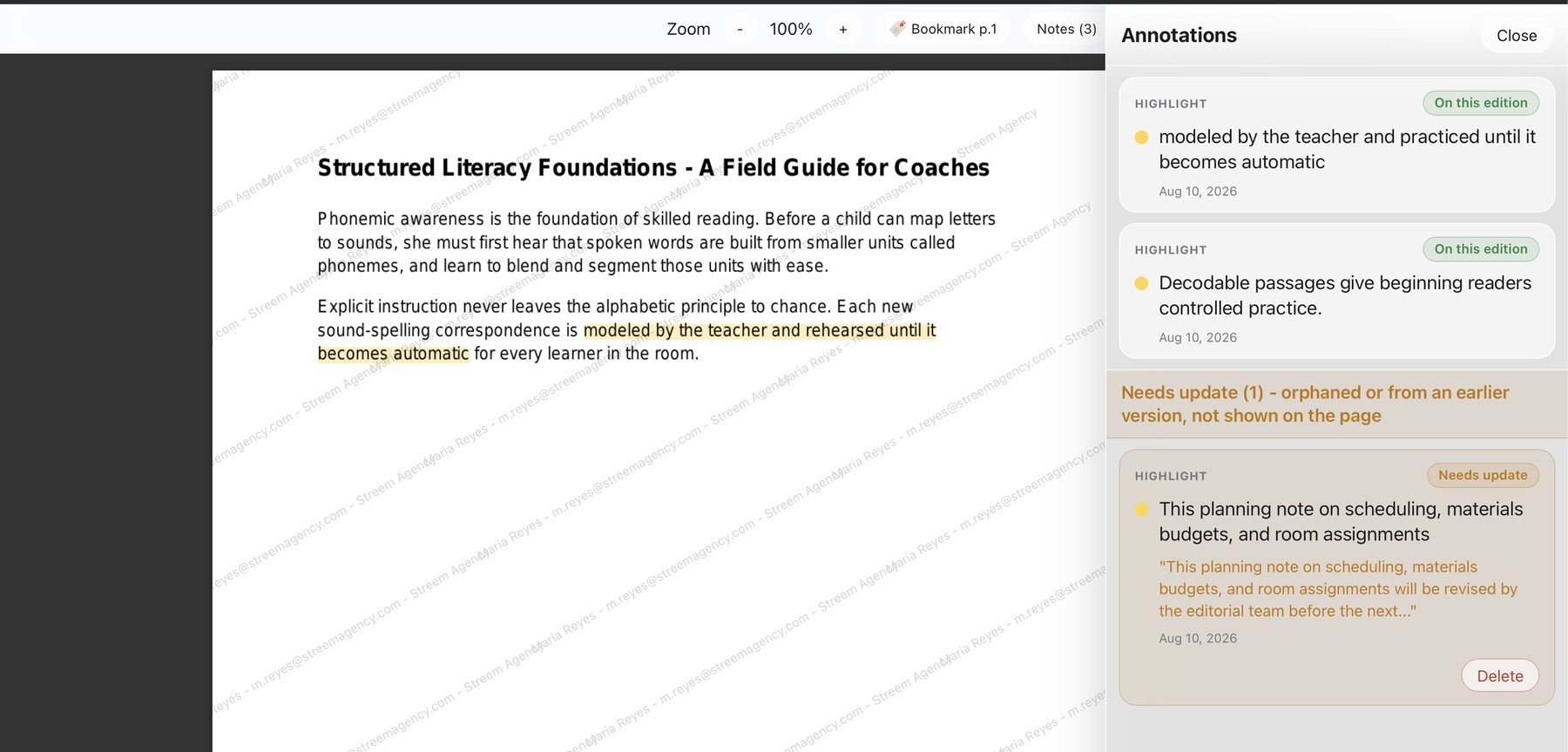
The Hylight reader after a new edition: two annotations marked On this edition, and one marked Needs update with the reader's original text preserved.
The reader after an edition change. Two marks carried across. The third was on a passage that got cut, so it's held for review with her original words — never moved somewhere it never was. Her name and email are woven across every page she opens.
A learner's Hylight library, showing the single title her cohort has been assigned.
A learner's library. She sees the one title her cohort was assigned — and nothing else in the catalogue.

Moving from another platform

Bring the catalogue. Keep the readers.

Most organizations come to us already renting a reader from someone else, with a catalogue that took years to build and a quiet worry about who really owns the relationship with their learners. We load your titles, stand the library up under your domain, and give you the publishing controls directly — so the next edition is something you ship, not something you file a ticket for.

See it with your own content.

Send us one title and a draft of its next edition. We'll show you exactly what happens to a reader's work when you publish it.